


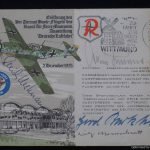

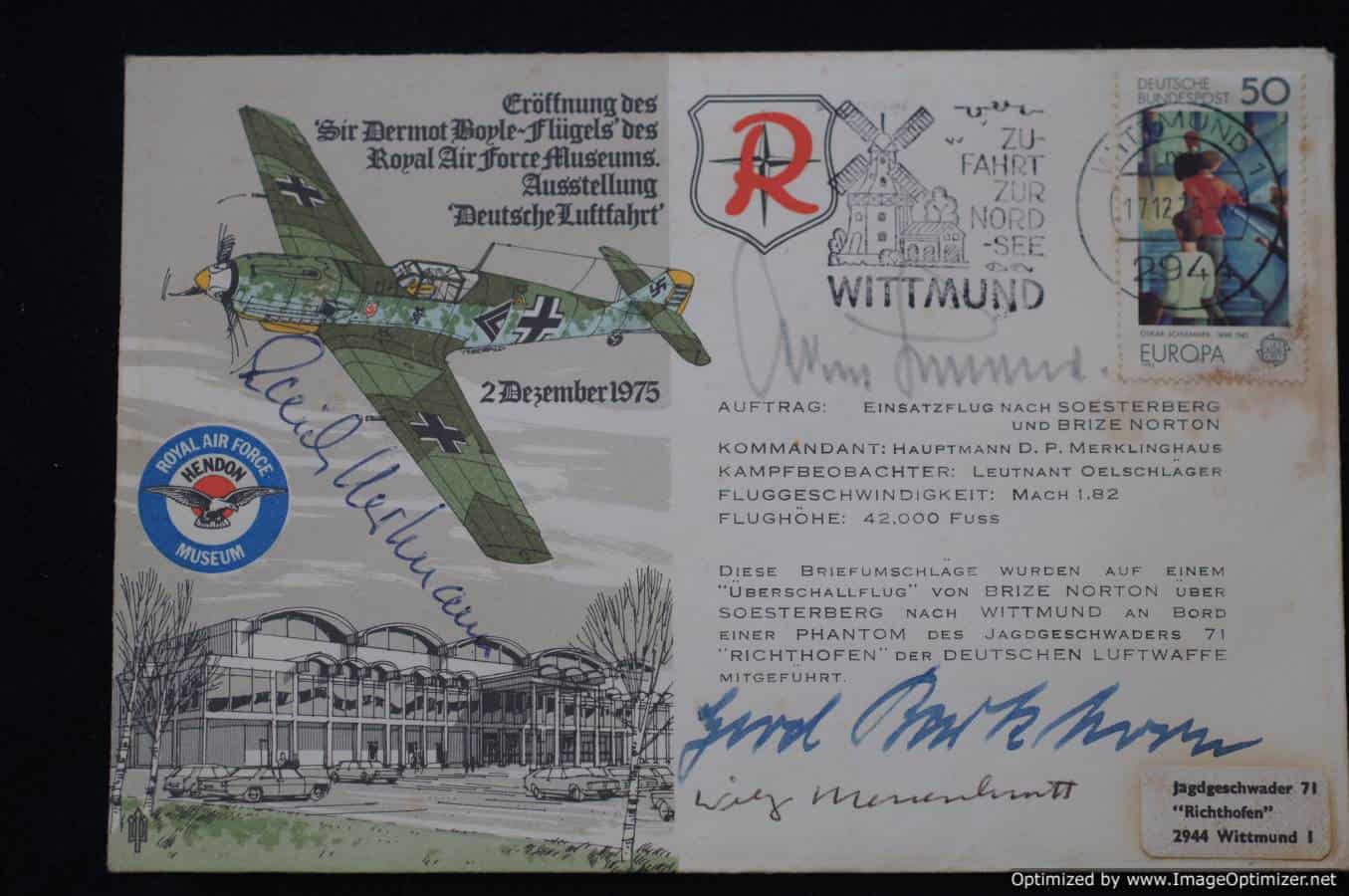
SMGL-141 WW2 4 person Signed comemorative Envelope, Hartmann, Galland, Barkhorn, Messserschmitt *SOLD
$400.00
Out of stock
Description
A rare chance to own some very desirable signatures on one item! Some very impressive persons in history have signed this envelope! These are super tough to come buy as they were signed in limited numbers and of coarse, they have all passed away. Many of these envelopes have been lost or discarded over the years and we are left with a very limited number of originals. This Envelope has Adolf Galland, Willy Messerschmitt, Eric Hartmann, and Barkhorn! A fantastic piece of history! There is some wear to the envelope and light soiling. There is a signature on the back which I’m not sure who or what it is. /////////////////////////////////////////////////////////////////////////////////////////////////////////////////////////////////////////////////////
Adolf Galland achieved 104 aerial victories in 705 missions, all on the Western front. Included in his score are at least seven victories flying the Me 262 and four four-engined bombers. He was himself shot down four times. ///////////////////////////////////////////////////////////////////////////////////////////////////////////////////////////////////////
Wilhelm Emil “Willy” Messerschmitt (German pronunciation: [‘m?s??m?t]) (26 June 1898 ? 15 September 1978) was a German aircraft designer and manufacturer. He was born in Frankfurt am Main, the son of Baptist Ferdinand Messerschmitt (1858?1916) and his second wife, Anna Maria n?e Schaller (1867?1942).[1][2]
Probably Messerschmitt’s single most important design was the Messerschmitt Bf 109, designed in 1934 with the collaboration of Walter Rethel. The Bf 109 became the most important fighter in the Luftwaffe as Germany rearmed prior to World War II. To this day, it remains one of the most-produced warplanes in history, with some 34,000 built, with only the Soviet Union Ilyushin Il-2 surpassing it at 36,000. Another Messerschmitt aircraft, first called “Bf 109R”, purpose-built for record setting, but later redesignated Messerschmitt Me 209, broke the absolute world airspeed record and held the world speed record for propeller-driven aircraft until 1969. His firm also produced the first jet-powered fighter to enter service ? the Messerschmitt Me 262, although Messerschmitt himself did not design it.//////////////////////////////////////////////////////////////////////////////////////////////////////////////////////////////////////////////////////
Gerhard Barkhorn was born on 20 May 1919 at K?nigsberg in East Prussia. He joined the Luftwaffe in 1937 as a Fahnenjunker. He began his flying training in March 1938 in the pre-war Luftwaffe. On completion of his training he was posted to 3./JG 2. On 1 August 1940 Leutnant Barkhorn was transferred to 6./JG 52 based on the Channel Front. He flew his initial missions with his new unit during the Battle of Britain but did not confirm any victories during this time. He was, however, shot down into the Channel on one occasion but was rescued unhurt. Barkhorn achieved his first success during his 120th mission on 2 July 1941 over the Eastern Front. Thereafter he was to score steadily, if relatively unspectacularly in comparison to other Eastern Front Luftwaffe aces, achieving his 10th victory on 30 November 1941. On 21 May, Barkhorn was appointed Staffelkapit?n of 4./JG 52. Barkhorn was not a prolific scorer; his best single mission netted him four victories, his best day seven victories. In May he recorded seven victories, 16 victories in June and 31 in July, including six on 19 July for his 46th through 51st victories, and five on 20 July (52-56). On 25 July, he was wounded in combat flying Bf 109 F-4 (W.Nr. 13 388) ?White 5?. Oberleutnant Barkhorn was awarded the Ritterkreuz on 23 August 1942 for 64 victories. After a two-month break away from the front he returned in early October. He recorded 14 victories in October, seven in November and 17 in December, including his 100th victory on 19 December. On 11 January 1943, he was awarded the Eichenlaub (Nr 175) when he achieved his 105th victory.
Gerd Barkhorn receiving congratulations from his Gruppe after his 250th victory.
Hauptmann Barkhorn became Gruppenkommandeur of II./JG 52 on 1 September 1943, and led it until 15 January 1945. He claimed 24 victories in August, including his 150th on 8 August. He claimed 15 victories in September, 23 in November, including his 200th victory on 30 November 1943, and 28 in December, including seven on 28 December (216-222). On 23 January 1944, Barkhorn became the first fighter pilot to have completed 1,000 combat missions. He achieved his 250th victory on 12 February, the second to do so. He was awarded the Schwertern on 2 March 1944 for 251 victories. Barkhorn?s success had not come without some cost. He was shot down nine times in his combat career. He baled out once and was wounded twice. On 31 May 1944, Barkhorn was flying his sixth mission of the day and, being fatigued, was not concentrating on keeping a good look-out when he was bounced by a Russian Airacobra fighter and shot down in Bf 109 G-6 (W.Nr. 163 195) ?<< Black 5?. He received severe wounds to his right arm and leg which put him out of action for four months. He returned to combat duty at the end of October. He claimed his 275th victim on 14 November. He recorded his 301st, and last, victory on 5 January 1945.
Barkhorn in his Fw 190D-9 on 17 February, 1945 in Welzow, Niederlausitz.
On 16 January 1945, Major Barkhorn was transferred to take command of JG 6 serving on Reichsverteidigung duties based at Posen. He led the unit until 10 April 1945 but was still suffering the effects of his wounds and eventually relinquished command for another spell in hospital. On recovery, Barkhorn joined JV 44 commanded by Generalleutnant Adolf Galland (104 victories, RK-Br) and operating the Me 262 jet fighter. On 21 April 1945, on the last of only two operational missions flying the Me 262, Barkhorn?s starboard engine failed. He was obliged to break off an attack on an American bomber formation and return to his base at Riem. He was chased by the USAAF P-51 fighter escort so set about landing his crippled machine in a clearing in some woods. In the resulting crash-landing the cockpit canopy, which he had opened to enable a quick escape, slammed shut on his neck. The incident put him back in hospital and out of the war. Post-war Barkhorn was one of the few noted Luftwaffe Experten who escaped being imprisoned by the Russians. However, he did become a prisoner of war of the Allies, finally being released by them in September 1945. He joined the Bundesluftwaffe in 1956, commanded JaboG 31 ?Boelcke? and rose to the rank of Generalleutnant. He retired in 1976. On 6 January 1983, during a winter storm on an autobahn near K?ln, Barkhorn and his wife, Christl, were involved in a serious automobile accident. Christl died at the scene but Gerhard lingered in a hospital for two days before passing away on 8 January.
Gerhard Barkhorn was credited with 301 victories gained in 1104 missions. All his victories were recorded while flying over the Eastern Front. //////////////////////////////////////////////////////////////////////////////////////////////////////////////////////////////////////////////////////////////////////////////////////////////
Erich ?Bubi? Hartmann was born on 19 April 1921 at Weissach in W?rttemberg. His early years were spent in China where his father, a doctor, had a general practice in Changsha. He returned to Germany with his family in 1928 and completed his schooling. Hartmann learned to fly sailplanes and had gained his pilot?s licence in 1939. He entered the Luftwaffe on 10 October 1940. Hartmann attended the Luftkriegsschule II (air combat school) at Berlin-Gatow gaining his military pilot?s licence in August 1941. From 14 October 1941 to February 1942 he attended Jagdfliegerschule-Vorschule 2 at Lachen-Speyerdorf. He attended Jagdfliegerschule 2 at Zerbst from February 1942 to July 1942 before being posted to Erg?nzungruppe Ost at Gleiwitz for operational training, which he completed in October 1942. His first operational posting was to 7./JG 52 on the Eastern Front on 10 October 1942. Leutnant Hartmann came under the guidance of Oberfeldwebel Edmund ?Paule? Rossmann (93 victories, RK, POW 9 July 1943), considered one of the best element leaders on the Eastern Front. During this time he was given the advice of several another accomplished aces of 7./JG 52, including Oberfeldwebel Alfred Grislawski (132 victories, RK-EL) and Leutnant Walter Krupinski (197 victories, RK-EL). Hartmann recorded his first victory, a Russian Il-2 Sturmovik ground-attack aircraft, shot down on 5 November 1942. However, he too was hit in the engagement and was forced to crashland. By the end of April 1943, his victory total stood at 11. On 23 May he claimed his 17th victory but two days later force-landed his Bf 109 G-4 ?White 2? (W.Nr. 14 997) after colliding with a LaGG-3 fighter. After this incident he was given leave to rest and recuperate, returning to combat duty by the end of June. By the end of July 1943 his victory total had reached 42, including seven enemy aircraft shot down on 7 July to record his 22nd through 28th victories. In August, he claimed 48 victories, including five on 1 August (43-47), 4 August (52-56), 5 August (57-61) and 7 August (63-67). However, following his 90th victory on 20 August 1943, Hartmann was shot down in Bf 109 G-6 (W.Nr. 20 485), and captured. Feigning injury, he managed to decoy his captors into not keeping a close watch on him and was able to escape and returned to his unit after two days. On 2 September 1943, Hartmann was appointed Staffelkapit?n of 9./JG 52. On 13 September he was awarded the Ehrenpokal. He gained his 100th victory on 20 September 1943. In October, he claimed 33 victories. Leutnant Hartmann was awarded the Ritterkreuz on 29 October 1943 after his 148th victory. On 6 December he was awarded the Deutsches Kreuz in Gold. He recorded his 150th victory on 13 December. On 30 January 1944, Hartmann shot down six enemy aircraft (178-183). He claimed five victories on 1 February (186-190). He brought up his 200th victory on the 26 February 1944, on a day when he shot down 10 Airacobra fighters (192-202). He was awarded the Eichenlaub (Nr 420) on 2 March. On 8 May, Hartmann, with two of his groundcrew in the baggage locker of his Bf 109, was forced to withdraw from the Crimea. He had 223 victories to his credit at the time. For a short period, Hartmann operated over Rumania intercepting the American daylight bombing raids on the Rumanian oil fields and installations, and on 24 June he claimed a 15th USAAF P-51 fighter as his 265th victory. On 2 July he was awarded the Schwertern (Nr. 75) for 266 victories. A Russian counter-offensive took the unit back to the Crimea and, during May and June 1944, he accounted for 60 Russian aircraft to bring his score to 267. In August 1944, Hartmann claimed 35 victories, including eight on 23 August (284-291). He became the first fighter pilot to record 300 victories on 24 August 1944, on a day when he shot down eleven enemy aircraft. Hartmann was awarded the Brillanten for 303 victories on 25 August 1944, only the 18th German soldier to receive this accolade. He was immediately prohibited from combat flying and was assigned to Erprobungskommando 262 to test fly the Me 262 jet fighter. In October, Hartman was able get the prohibition on his combat flying lifted. On 1 October he was appointed Staffelkapit?n of 4./JG 52 (or 7./JG 52?) based in Hungary. By the end of 1944, he had raised his victory tally to 331. From 1 to 14 February 1945, Hartmann briefly led I./JG 53 in an acting Gruppenkommandeur role. He relinquished the role to Hauptmann Helmut Lipfert (203 victories, RK-EL) on 15 February. In mid-February 1945, Hartmann was given command of I./JG 52. In March he was transferred to Lechfeld for short training on the Me 262 jet fighter before requesting to return to JG 52. He became the only man ever to achieve 350 victories on 17 April 1945 and in late April he was promoted to Major. On 8 May 1945 he claimed his 352nd, and last, victory against a Yak-9 fighter over the Br?nn area in Czechoslovakia. Major Hartmann surrendered his unit to an American armoured unit but on 24 May he was handed over to the Russians. He was to be sentenced to 25 years hard labour by the Russians, serving 10 years before returning to Germany on 15 October 1955. He served in the reformed Luftwaffe from 1956 and commanded JG 71. He retired from active duty in 1970. Erich Hartmann died on 19 September 1993 at Weil im Sch?nbuch.
Erich Hartmann was the top scoring fighter pilot of all the combatants in World War 2. He flew 825 missions in recording 352 victories. All his victories were recorded on the Eastern Front and included 15 Il-2 Sturmovik ground-attack aircraft. He force-landed 14 times during his combat career.

Do you have
Unwanted Militaria?
Whether it’s individual pieces or full collections, we’ll buy it!