


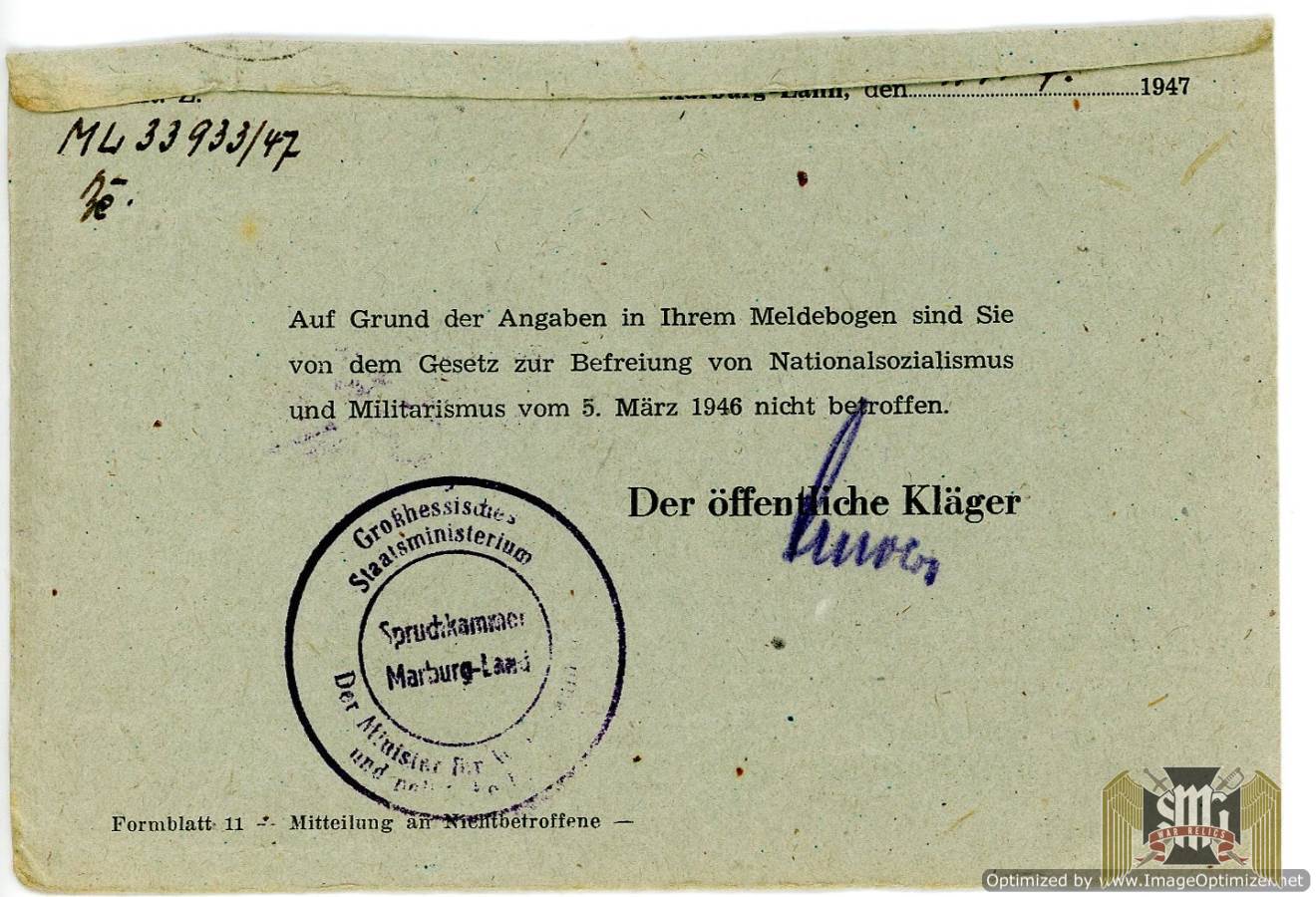
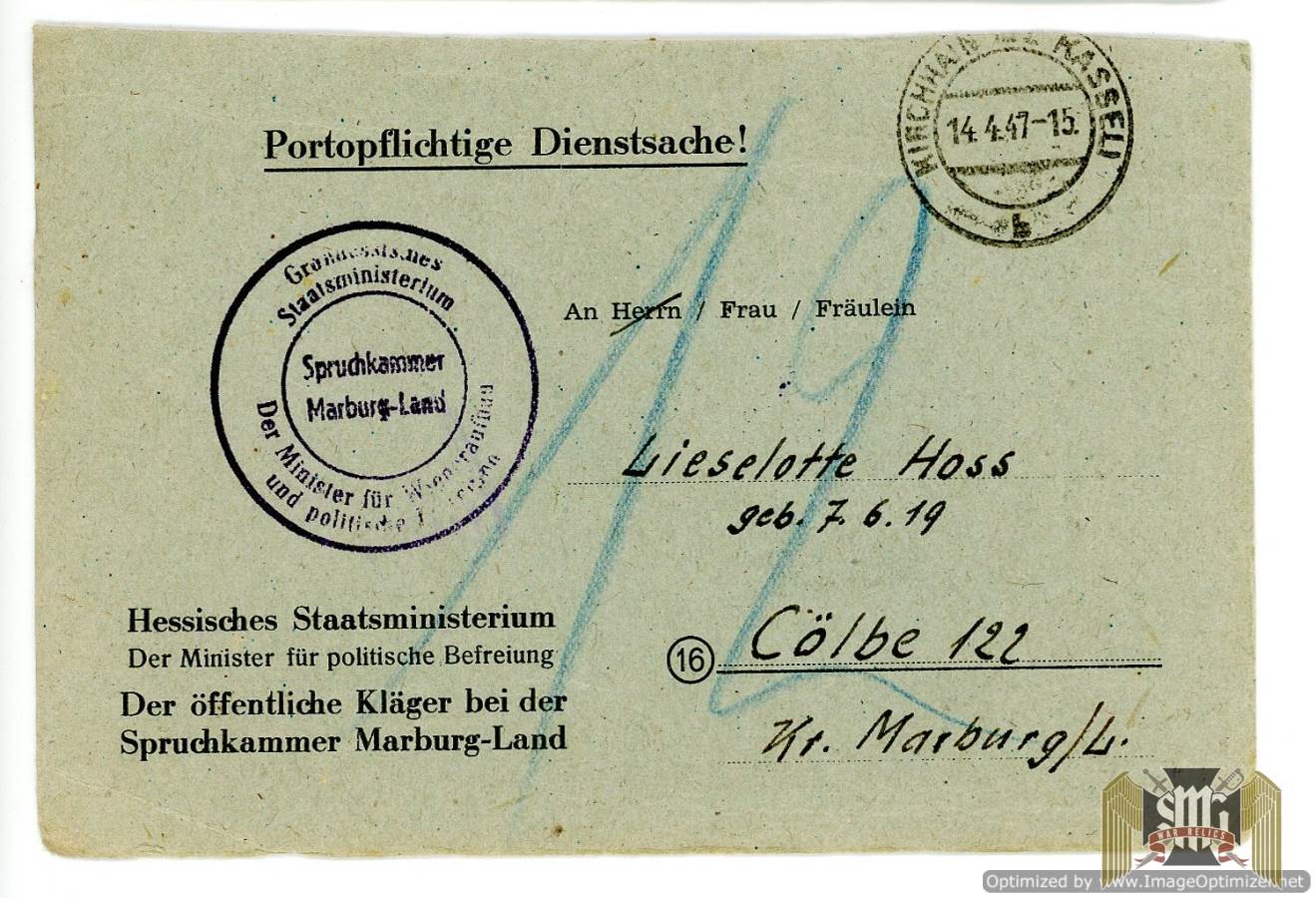
SMGM-3956 exemption from law 104 certificate for “Lieselotte”
$15.00
1 in stock
Description
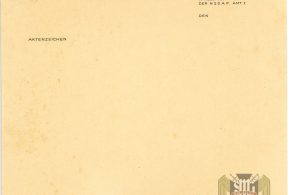
A pretty neat document and important for the addressee to hold on to!
From alliiertenmuseum.de:
There was disagreement among the four occupying powers about the specifics of how the political cleansing should be carried out; initially, there was neither a joint course of action nor a joint objective, and the denazification procedures differed accordingly. It was not until January 1946, after long discussion, that the Allied Control Council issued Directive no. 24 containing guidelines for a coordinated approach across Germany.
German “Law 104 for Liberation from National Socialism and Militarism” of March 5, 1946 established five categories for classifying people. They were: “1. Major Offenders, 2. Offenders (activists, militarists, and beneficiaries), 3. Lesser Offenders (probation group), 4. Followers, and 5. Persons Exonerated.
The occupying powers turned responsibility for denazification over to the Germans as early as 1945/46. In each occupation zone, various forms of commissions, committees, and denazification tribunals called spruchkammer, made up of former resistance fighters, unionists, professional and lay judges, and similar people, vetted individuals. In quadripartite Berlin, there was a joint procedure for the four powers – at least on paper. In all of the occupation zones and/or sectors, the classification and ruling by the spruchkammer, commissions, and committees was made on the basis of a comprehensive questionnaire. The respondents had to provide detailed and truthful information about their political biography, including membership in the Nazi Party or any other Nazi organization. The sanctions that might be imposed included fines, forced retirement, or even confinement to a labor camp. Many people produced exculpatory sworn statements. Since incriminating documents were often difficult to unearth, those written attestations – from friends or neighbors, say – contributed significantly to the fact that the overwhelming majority of cases were classified in the 4th category “Followers.” Only 1.4 percent of the people undergoing denazification ended up classified as “Major Offenders” or “Offenders.” An official ruling that a person had been classified as “Exonerated” or a “Follower” – and by association, the exculpatory sworn statements – were later to be known colloquially as “persil” certificates, a reference to a popular laundry detergent, meaning the document had “whitewashed” the possible guilt of its holder.
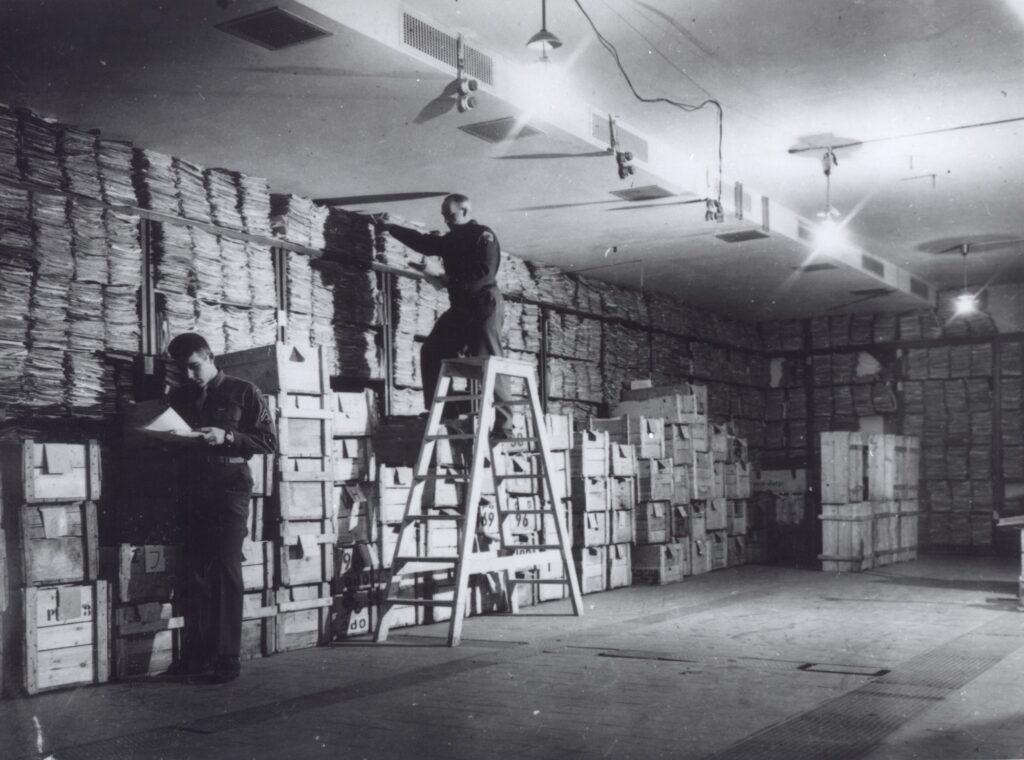
DIFFERENCES BETWEEN THE FOUR OCCUPATION ZONES
Although the Allies had all agreed on the five categories of culpability, the denazification process continued to be implemented to differing degrees in the individual occupation zones. The Americans carried out the most extensive bureaucratic operation.
Denazification in the British and French occupation zones was much smaller in scope than in the American zone and was handled in a far more pragmatic manner. The British prioritized the efficiency of the German administrative authorities, as well as the economy – taking into consideration the country’s level of destruction, along with housing and drastic food shortages – above any extensive cleansing of the ranks. Sometimes-contradictory guidelines were often implemented with long delays and the procedure was complicated. In the French occupation zone, denazification policies had a largely improvisational character, as well as being directed towards French national interests. The French focused their denazification on the civil service and large-scale industry; they made no effort to implement the kind of rigid political cleansing that was initially attempted in the U.S. occupation zone.



Do you have
Unwanted Militaria?
Whether it’s individual pieces or full collections, we’ll buy it!