


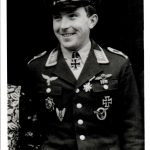
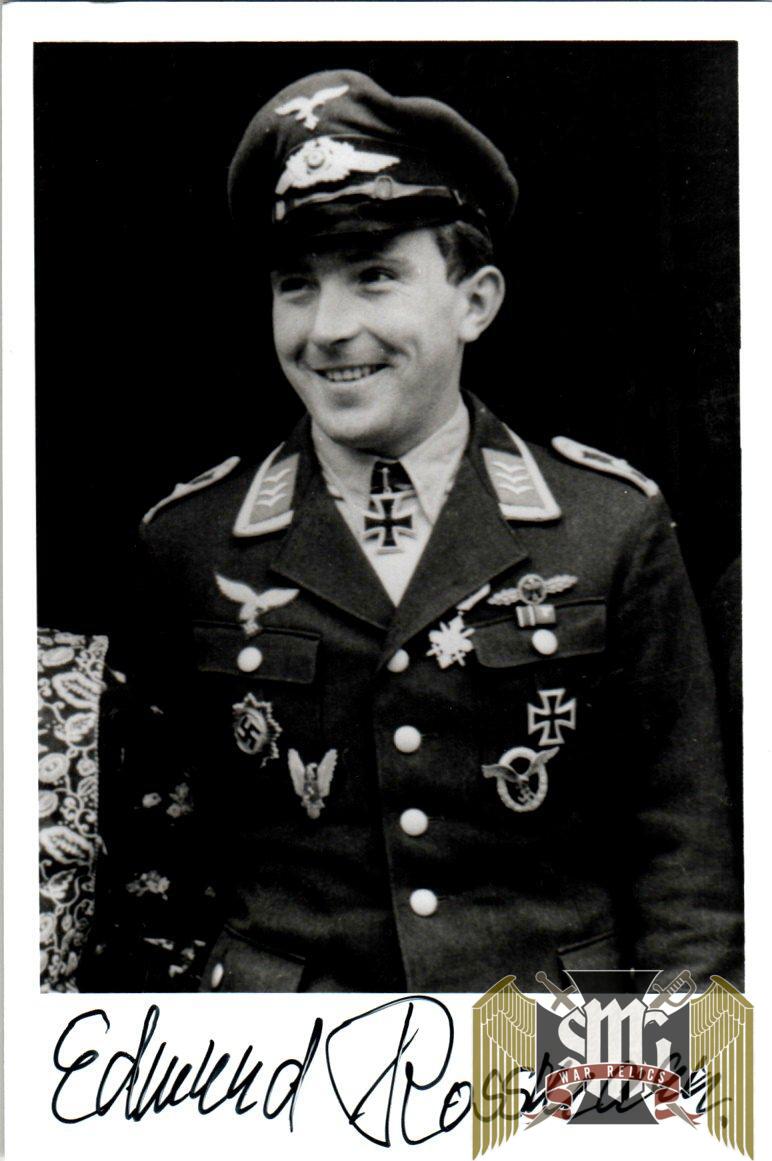
SMGP-1928 Edmund Rossmund Luftwaffe Ace knights cross Signature
$35.00
1 in stock
Description
A 4×6″ a glossy print with authentic post war signature in black marker.
From Wikipedia:
Edmund “Paule” Roßmann (11 January 1918 – 4 April 2005) was a Nazi Germany Luftwaffe fighter ace during World War II. He was credited with 93 aerial victories achieved in 640 combat missions, among the numerous ground attack missions. A flying ace or fighter ace is a military aviator credited with shooting down five or more enemy aircraft during aerial combat.[1] He is also noted as being an early mentor of Erich Hartmann, history’s leading fighter ace.
Early life and career
Roßmann was born on 11 January 1918 in Caaschwitz in the Principality of Reuss-Gera within the German Empire.[2] Following completion of his flight and fighter pilot training,[Note 1] Roßmann was posted to 7. Staffel (7th squadron) of Jagdgeschwader 52 (JG 52—52nd Fighter Wing) on 1 March 1940 holding the rank of Unteroffizier (non-commissioned officer). At the time, 7. Staffel was commanded by Oberleutnant Herbert Ferner. The Staffel was subordinated to III. Gruppe (3rd group) of JG 52 headed by Major Wolf-Heinrich von Houwald.[4] The Gruppe had been formed on 1 March 1940 at Strausberg and was equipped with the Messerschmitt Bf 109 E-1 and E-3. On 6 April, the Gruppe was moved to Mannheim-Sandhofen Airfield where it was placed under the control of the Stab (headquarter unit) of Jagdgeschwader 53 (JG 53–53rd Fighter Wing).[5]
World War II
World War II in Europe had begun on Friday, 1 September 1939 when German forces invaded Poland. On 1 July 1940, III. Gruppe transferred from Jever Airfield to Werneuchen.[6] According to Mathews and Foreman, Roßmann filed claim for an unconfirmed aerial victory over an unknown type of aircraft that day.[7] This claim is not listed by Barbas nor by Prien, Stemmer, Rodeike and Bock.[8][9]
On 21 July during the Kanalkampf phase of the Battle of Britain, Roßmann claimed a Fairey Swordfish torpedo bomber shot down over the English Channel.[10] Three days later, Roßmann claimed a Supermarine Spitfire shot down north of Margate. That day, III. Gruppe had engaged in combat with Royal Air Force (RAF) Spitfires from No. 610 Squadron on a fighter escort mission for 15 Dornier Do 17 bombers attacking shipping in the Thames Estuary. Roßmann’s claim was not confirmed.[11] On 29 July, Roßmann had a mid-air collision with a Spitfire fighter in the combat area near Dover.[12] The following day, III. Gruppe, which had sustained heavy casualties during the Battle of Britain, was withdrawn from the English Channel and ordered to relocate to Leeuwarden Airfield. The Gruppe was then ordered to Zerbst on 1 August before moving to Merseburg on 25 August, to Neuruppin on 7 September and to Schönwalde on 18 September. At Schönwalde, III. Gruppe continued training, in particular aerial gunnery was practiced. On 7 October, the Gruppe was placed under command of Major Gotthard Handrick.[13]
The rise of General Ion Antonescu in Romania in 1940 led to a reorganization of his country’s armed forces. In this, he was supported by a military mission from Germany, the Luftwaffenmission Rumänien (Luftwaffe Mission Romania) under the command of Generalleutnant (equivalent to major general) Wilhelm Speidel.[14][15] Luftwaffenmission Rumänien also defended Germany’s southeastern borders, with its primary objective defending the oil fields and refineries at Ploiești. On 15 October, the Stab and 9. Staffel of III. Gruppe of JG 52 were sent to Bucharest Pipera Airfield, followed by 7. And 8. Staffel in late November. There, the III. Gruppe of JG 52 temporarily became the I. Gruppe of Jagdgeschwader 28 (JG 28—28th Fighter Wing). On 4 January 1941, the Gruppe again became the III. Gruppe of JG 52. On 25 May, III. Gruppe was sent to Greece where it was subordinated to Jagdgeschwader 77 (JG 77—77th Fighter Wing) and fought in the Battle of Crete.[16]
War against the Soviet Union
Following its brief deployment in the Balkan Campaign, III. Gruppe was back in Bucharest by mid-June.[17] There, the unit was again subordinated to the Luftwaffenmission Rumänien and reequipped with the new, more powerful Bf 109 F-4 model. On 21 June, the Gruppe was ordered to Mizil in preparation of Operation Barbarossa, the German invasion of the Soviet Union. Its primary objective was to provide fighter protection for the oil fields and refineries at Ploiești.[18] Prior to the invasion, Major Gotthard Handrick was replaced by Major Albert Blumensaat as commander of III. Gruppe. Blumensaat was then replaced by Hauptmann Hubertus von Bonin on 1 October. At the time, von Bonin was still in convalescence so that Hauptmann Franz Höring, the commander of 9. Staffel, was also made the acting Gruppenkommandeur (group commander).[19] The invasion of the Soviet Union began on 22 June. The next day, the Gruppe moved to Mamaia, the northern district of Constanța on the Black Sea coast.[20] On 25 June, Roßmann claimed his first confirmed aerial victory when he shot down a Soviet Ilyushin DB-3 bomber.[21]
Roßmann received the Honor Goblet of the Luftwaffe (Ehrenpokal der Luftwaffe) on 17 November.[22] By the end of 1941 he had accumulated 32 aerial victories. On 19 March 1942, Roßmann and fellow JG 52 pilot Leutnant Adolf Dickfeld were awarded the Knight’s Cross of the Iron Cross (Ritterkreuz des Eisernen Kreuzes).[23] From March to June 1942, he was posted to Ergänzungs-Jagdgruppe Ost (Supplementary Fighter Group, East) as fighter pilot instructor and returned to his Staffel afterwards. Nevertheless, he almost doubled his score by the end of 1942 and claimed his 80th victory on 29 November 1942. At the time, he was an early mentor of Erich Hartmann, history’s leading fighter ace.[24] When in March 1943, Oberleutnant Walter Krupinski was appointed Staffelkapitän (squadron leader) of 7. Staffel, Roßmann was assigned as his wingman and assisted in familiarizing him with the combat conditions over the Kerch Peninsula.[25]
On 5 July 1943 on the first day of Operation Citadel, Roßmann claimed three aerial victories.[26] Four days later on 9 July, Roßmann attempted to rescue Feldwebel Ernst Lohberg who had crash landed behind enemy lines, approximately 20 kilometers (12 miles) west of Oboyan. Roßmann successfully landed his Bf 109 G-6 (Werknummer 20154—factory number) next to Lohberg’s aircraft. At this moment, the Soviet infantry arrived, while Lohberg was shot, Roßmann was taken prisoner of war.[27][28]
Later life
Roßmann died on 4 April 2005 at the age of 87 in Krefeld, Germany.[29]
Summary of career
Aerial victory claims
According to US historian David T. Zabecki, Roßmann was credited with 93 aerial victories.[30] Spick also lists Roßmann with 93 aerial victories claimed in approximately 640 combat missions. This figure includes 87 aerial victories on the Eastern Front, and further six victories over the Western Allies.[31] Mathews and Foreman, authors of Luftwaffe Aces — Biographies and Victory Claims, researched the German Federal Archives and found records for 93 aerial victory claims, plus six further unconfirmed claims. All of his confirmed aerialvitories were claimed on the Eastern Front.[32]
Victory claims were logged to a map-reference (PQ = Planquadrat), for example “PQ 44457”. The Luftwaffe grid map (Jägermeldenetz) covered all of Europe, western Russia and North Africa and was composed of rectangles measuring 15 minutes of latitude by 30 minutes of longitude, an area of about 360 square miles (930 km2). These sectors were then subdivided into 36 smaller units to give a location area 3 km × 4 km (1.9 mi × 2.5 mi) in size.[33]
| Chronicle of aerial victories | |||||||||
|---|---|---|---|---|---|---|---|---|---|
|
This and the – (dash) indicates unconfirmed aerial victory claims for which Roßmann did not receive credit.
This and the ? (question mark) indicates information discrepancies listed by Prien, Stemmer, Rodeike, Bock, Mathews and Foreman.
|
|||||||||
| Claim | Date | Time | Type | Location | Claim | Date | Time | Type | Location |
| – 7. Staffel of Jagdgeschwader 52 –[7] Action at the Channel and over England — 26 June – 1 August 1940 |
|||||||||
|
—
|
1 July 1940 |
—
|
unknown[7] |
—
|
24 July 1940 |
—
|
Spitfire | northeast of Margate[9] | |
|
—
|
21 July 1940 |
—
|
Swordfish | English Channel[9] |
—
|
25 July 1940 |
—
|
Bréguet 690 | 40 km (25 mi) east of Margate[9] |
|
—
|
21 July 1940 |
—
|
unknown | Strait of Dover[7] |
—
|
29 July 1940 |
—
|
Spitfire | Dover[7] |
| – 7. Staffel of Jagdgeschwader 52 –[34] Operation Barbarossa — 22 June – 5 December 1941 |
|||||||||
| 1 | 25 June 1941 | 17:40 | DB-3 | southeast of Constanța[35] | 16 | 17 September 1941 | 10:30 | I-16 | Brovary[36] |
| 2 | 8 July 1941 | 15:56?[Note 3] | DB-3 | northeast of Mamaia[37] | 17 | 2 October 1941 | 08:25 | I-26 (Yak-1) | east of Poltava[38] |
| 3 | 8 July 1941 | 16:00 | DB-3 | northeast of Mamaia[37] | 18 | 3 October 1941 | 17:10 | R-10 (Seversky) | north of Karjap[38] |
| 4 | 8 July 1941 | 16:03 | DB-3 | northeast of Mamaia[37] | 19 | 4 October 1941 | 12:10 | ground-attack aircraft (Seversky) | south of Covaci[38] |
| 5 | 4 August 1941 | 05:55 | I-16[37] | 20 | 14 October 1941 | 16:30 | I-26 (Yak-1)[39] | ||
| 6 | 4 August 1941 | 14:35 | I-18 (MiG-1)[40] | 21 | 14 October 1941 | 16:50 | I-16[39] | ||
| 7 | 7 August 1941 | 06:15 | I-16[40] | 22 | 17 October 1941 | 07:21 | I-26 (Yak-1)[39] | ||
| 8 | 7 August 1941 | 06:40 | DB-3[40] | 23 | 24 October 1941 | 12:45 | I-15 | Chaplynka[41] | |
| 9 | 11 August 1941 | 09:29 | I-18 (MiG-1)[40] | 24 | 24 October 1941 | 12:50 | I-61 (MiG-3) | Chaplynka[41] | |
| 10 | 26 August 1941 | 10:40 | I-16[36] | 25 | 25 October 1941 | 11:45 | I-16[41] | ||
| 11 | 1 September 1941 | 11:16 | I-17 (MiG-1)[36] | 26 | 31 October 1941 | 15:32 | I-61 (MiG-3)[42] | ||
| 12 | 7 September 1941 | 09:25 | I-16 | Stschastliwaja[36] | 27 | 9 November 1941 | 11:21 | V-11 (Il-2)[42] | |
| 13 | 7 September 1941 | 09:30 | I-17 (MiG-1)[36] | 28 | 16 November 1941 | 13:31 | I-26 (Yak-1)[43] | ||
| 14 | 7 September 1941 | 11:41 | DB-3[36] | 29 | 28 November 1941 | 12:53 | I-61 (MiG-3)[43] | ||
| 15 | 13 September 1941 | 12:45?[Note 4] | I-17 (MiG-1) | 50 km (31 mi) northwest of Dnepropetrovsk[36] 3 km (1.9 mi) northeast of Dnepropetrovsk |
30 | 2 December 1941 | 08:10 | I-16[43] | |
| – 7. Staffel of Jagdgeschwader 52 –[44] Eastern Front — 6 December 1941 – 28 April 1942 |
|||||||||
| 31 | 8 December 1941 | 09:12 | I-16[45] | 39 | 17 February 1942 | 08:02 | I-61 (MiG-3)[46] | ||
| 32 | 11 December 1941 | 10:47 | V-11 (Il-2)[45] | 40 | 17 February 1942 | 10:32 | I-61 (MiG-3)[46] | ||
| 33 | 4 January 1942 | 13:03 | LaGG-3[47] | 41 | 17 February 1942 | 10:36 | I-16[46] | ||
| 34 | 5 January 1942 | 12:00 | DB-3[47] | 42 | 18 February 1942 | 16:09 | I-61 (MiG-3)[46] | 20 km (12 mi) northeast of Belgorod | |
| 35 | 7 January 1942 | 09:30 | DB-3 | 5 km (3.1 mi) west of Karankut[47] | 43 | 22 February 1942 | 15:36 | I-61 (MiG-3)[48] | |
| 36 | 15 January 1942 | 10:25 | DB-3 | 5 km (3.1 mi) west of Karankut[49] | 44 | 16 March 1942 | 10:31 | I-16[48] | |
| 37 | 15 January 1942 | 14:50 | DB-3[49] | 45 | 16 March 1942 | 11:47 | Il-2[48] | ||
| 38 | 17 February 1942 | 07:59 | Su-2 (Seversky)[46] | ||||||
| – 7. Staffel of Jagdgeschwader 52 –[44] Eastern Front — 29 April 1942 – 3 February 1943 |
|||||||||
| 46 | 13 June 1942 | 16:15 | LaGG-3[50] | 65 | 6 September 1942 | 14:47 | LaGG-3 | PQ 44457[51] vicinity of Mozdok |
|
| 47 | 23 June 1942 | 16:35 | MiG-1[50] | 66 | 6 September 1942 | 16:50 | I-16 | PQ 4444[51] | |
| 48 | 23 June 1942 | 16:37 | Hurricane | PQ 70332[50] vicinity of Shevchenkovo |
67 | 7 September 1942 | 12:05 | I-16 | PQ 44474[51] |
| 49 | 21 July 1942 | 15:20 | I-16 | PQ 98821[52] vicinity of Rostov |
68 | 8 September 1942 | 13:50?[Note 5] | LaGG-3 | PQ 44472[51] south of Mozdok |
| 50 | 23 July 1942 | 07:15 | I-16[52] | 69 | 8 September 1942 | 13:51 | LaGG-3 | PQ 44443, north of Georgjewsk[51] | |
| 51 | 24 July 1942 | 06:28 | I-16[52] | 70 | 13 September 1942 | 09:35 | LaGG-3 | PQ 44362[53] | |
| 52 | 24 July 1942 | 09:50 | LaGG-3[52] | 71 | 19 September 1942 | 16:38 | LaGG-3 | PQ 54351[54] | |
| 53 | 23 August 1942 | 05:35 | I-16 | PQ 44251[55] | 72 | 29 September 1942 | 10:40 | I-16 | PQ 44533, south of Nizhniy Kurp[56] |
| 54 | 23 August 1942 | 05:37 | I-153?[Note 6] | PQ 44213[55] | 73 | 9 October 1942 | 09:07 | I-16 | PQ 44484[56] |
| 55 | 23 August 1942 | 16:35 | LaGG-3 | PQ 44281[55] | 74 | 9 October 1942 | 13:25 | LaGG-3 | PQ 44623[56] vicinity of Malgobek |
| 56 | 24 August 1942 | 11:45 | Il-2?[Note 7] | PQ 44374[55] | 75 | 15 October 1942 | 09:30 | LaGG-3 | PQ 44453[56] south of Mozdok |
| 57 | 26 August 1942 | 17:23 | LaGG-3 | PQ 44471[55] south of Mozdok |
76 | 29 October 1942 | 10:15 | LaGG-3 | PQ 44551[57] southwest of Daiskoje |
| 58 | 28 August 1942 | 14:16 | LaGG-3 | PQ 44454[58] south of Mozdok |
77 | 29 October 1942 | 13:35 | LaGG-3 | PQ 34694[57] |
| 59 | 30 August 1942 | 09:57 | I-16 | PQ 54213[58] vicinity of Volkenskoje |
78 | 6 November 1942 | 08:15 | I-16 | PQ 44857[59] |
| 60 | 30 August 1942 | 09:59 | LaGG-3 | PQ 54373[58] | 79 | 6 November 1942 | 11:34 | LaGG-3 | PQ 44764[59] |
| 61 | 30 August 1942 | 10:01 | LaGG-3 | PQ 54342[58] vicinity of Beketowka |
80 | 29 November 1942 | 05:47 | R-5 | PQ 44793[60] |
| 62 | 30 August 1942 | 11:23 | LaGG-3 | PQ 54371[58] vicinity of Kalinowskaja |
81 | 8 December 1942 | 09:54 | LaGG-3 | PQ 44567[60] |
| 63 | 5 September 1942 | 11:00?[Note 8] | LaGG-3 | PQ 54454[61] vicinity of Wosnessnokaja |
82 | 8 December 1942 | 10:00 | Il-2 | PQ 44551[60] west of Elkhotovo |
| 64 | 6 September 1942 | 07:35 | I-16 | PQ 44453[61] south of Mozdok |
|||||
| – 7. Staffel of Jagdgeschwader 52 –[62] Eastern Front — 3 February – 9 July 1943 |
|||||||||
| 83 | 28 March 1943 | 05:40 | LaGG-3 | PQ 34 Ost 86571[63] northwest of Sslaeanskaja |
89 | 5 July 1943 | 03:55 | LaGG-3 | PQ 35 Ost 61442[64] 10 km (6.2 mi) north of Belgorod |
| 84 | 30 April 1943 | 08:30 | LaGG-3 | PQ 34 Ost 85173[65] southwest of Krymsk |
90 | 5 July 1943 | 18:09 | LaGG-3 | PQ 35 Ost 61652[64] 15 km (9.3 mi) northwest of Vovchansk |
| 85 | 30 April 1943 | 08:32 | LaGG-3 | PQ 34 Ost 85174[65] east of Krymsk |
91 | 5 July 1943 | 18:12 | Il-2 | PQ 35 Ost 61652[64] 15 km (9.3 mi) northwest of Vovchansk |
| 86 | 6 May 1943 | 16:47 | LaGG-3 | PQ 34 Ost 76693[66] west of Slavyansk-na-Kubani |
92 | 6 July 1943 | 10:30 | Il-2 m.H.[Note 9] | PQ 35 Ost 61652[64] 15 km (9.3 mi) northwest of Vovchansk |
| 87 | 31 May 1943 | 09:55 | LaGG-3 | PQ 34 Ost 75232, north of Krymskaya[67] | 93 | 7 July 1943 | 04:58 | Il-2 m.H.[Note 9] | PQ 35 Ost 61634[68] 15 km (9.3 mi) north of Vovchansk |
| 88 | 31 May 1943 | 14:11 | Pe-2 | PQ 34 Ost 75232, north of Krymskaya[67] | |||||
Awards
- Iron Cross (1939) 2nd and 1st Class[69]
- Honor Goblet of the Luftwaffe on 17 November 1941 as Unteroffizier and pilot[70][Note 10]
- German Cross in Gold on 22 January 1942 as Feldwebel in the III./Jagdgeschwader 52[71]
- Knight’s Cross of the Iron Cross on 19 March 1942 as Feldwebel and pilot in the 7./Jagdgeschwader 52[72][73]

Do you have
Unwanted Militaria?
Whether it’s individual pieces or full collections, we’ll buy it!