


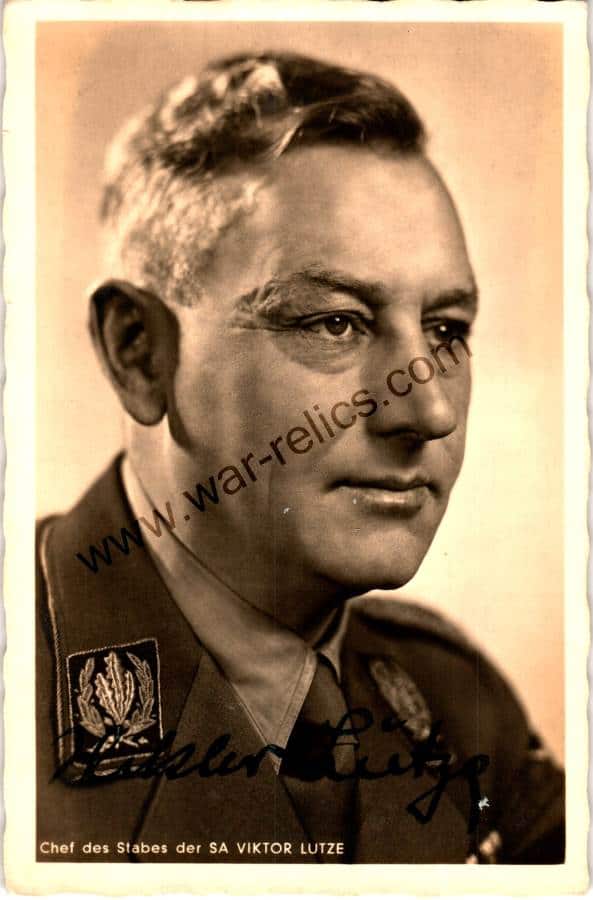
SMGQ-0323 Viktor Lutze Autographed Post Card
$600.00
Out of stock
Description
An authentic 1943 or earlier signature on a post card. Lutze died in 1943 in a car accident. This is your chance to own a historically significant signature by one of the men who organized the Night of the Long Knives. After the SA leadership purge, Lutze was promoted to Röhm’s position and was given the task of reducing the size of the insanely large SA organization.
From Wikipedia:
Viktor Lutze (28 December 1890 – 2 May 1943) was a German Nazi Party functionary and the commander of the Sturmabteilung (“SA”) who succeeded Ernst Röhm as Stabschef and Reichsleiter. He died from injuries received in a car accident. Lutze was given an elaborate state funeral in Berlin on 7 May 1943.
Early life[edit]
Lutze was born in Bevergern, Westphalia, in 1890.[1] He was employed by the Reichspost from 1907 until he joined the Prussian Army in 1912.[2] He served with the 55th Infantry Regiment, and then fought in the 369th Infantry Regiment and 15th Reserve Infantry Regiment during the First World War. He served as a platoon leader and a company commander, losing an eye in combat. After discharge in 1919 with the rank of Oberleutnant, Lutze returned to his postal job, then became a salesman and a business manager. He also joined the Deutschvölkischer Schutz- und Trutzbund, the largest, most active and most influential anti-Semitic organization in the Weimar Republic.[3]
Nazi Party and SA[edit]
Lutze joined the National Socialist German Workers Party (NSDAP; Nazi Party) in 1922, and the SA in 1923.[1] He became an associate of Franz Pfeffer von Salomon, the first leader of the SA. Together, they determined the structure of the organization.
He also worked with Albert Leo Schlageter in the resistance/sabotage of the Belgian and French occupation of the Ruhr in 1923. He became the deputy Gauleiter for the Ruhr in 1926.[2] His organization of the Ruhr for the SA became a model for other regions. In 1930, he was elected to the Reichstag as a representative for Hannover-Braunschweig.[2] In October 1931, he organized a huge joint rally in Braunschweig (Brunswick) of SA and SS men to show both strength in strife-weary Germany and loyalty to their leader, Adolf Hitler. This was before Hitler came to national power as Chancellor of Germany in January 1933.[4] Over 100,000 men attended the rally hosted by SA-Gruppe Nord under the leadership of Lutze. At the rally, the SA assured Hitler of their loyalty and Hitler in turn increased the size of the SA with the creation of 24 new Standarten (regiment-sized formations). Hitler never forgot this show of loyalty by Lutze. A badge was made to commemorate the event.[5] Lutze rose through the ranks and by 1933 was a SA-Obergruppenführer. On 15 February 1933, he was appointed police president of the Prussian Province of Hanover and on 25 March 1933 became the Oberpräsident of the provincial government, serving until 28 March 1941.[6][7]
Purge of Röhm[edit]
Lutze played an important part in the Night of the Long Knives (June–July 1934): he informed Hitler about Ernst Röhm‘s anti-régime activities. In preparation for the purge, both Heinrich Himmler and his deputy Reinhard Heydrich, chief of the SS Security Service (SD), assembled dossiers of manufactured evidence to suggest that Röhm planned to overthrow Hitler.[8] Meanwhile, Göring, Himmler, Heydrich and Lutze (at Hitler’s direction) drew up lists of those who should be liquidated, starting with seven top SA officials and including many more. The names of eighty-five victims are known; however, estimates place the total number killed at up to 200 people.[9]
After the purge Lutze succeeded Röhm as Stabschef SA, but after the Night of the Long Knives, the SA no longer had as prominent a role as it had in the early days of the party.[6] Lutze’s major tasks included overseeing a large reduction in the SA, a task welcomed by the SS and by the regular armed forces. On 30 June 1934 Hitler issued a twelve-point directive to Lutze to clean up and re-organize the SA.[2] On 20 July 1934, Lutze also was appointed to Röhm’s position as a Reichsleiter, the second highest political rank in the Nazi Party. On 26 June 1935, he was made a member of the Hans Frank‘s Academy for German Law. He retained these positions until his death.[10]

Hitler (centre, in front of the wreath), Lutze (on Hitler’s left), and Himmler (on Hitler’s right), giving a Nazi salute in front of the First World War cenotaph in the 1934 Nuremberg rally.
At the Nazi Party Congress in Nuremberg in September 1934, William L. Shirer observed Hitler speaking to the SA for the first time since the purge (Hitler absolved the SA from crimes committed by Röhm). Shirer also noted Lutze speaking there (Lutze reaffirmed the SA’s loyalty). Shirer described Lutze as possessing a shrill unpleasant voice, and thought the “SA boys received him coolly”. Leni Riefenstahl‘s film Triumph of the Will, however, shows the SA mobbing Lutze as he departs at the end of his evening-rally speech. His automobile can barely make it through the crowd. Alone among the speakers (apart from Hitler) Lutze receives the dramatic low-angle shots while standing solo at the podium. Riefenstahl’s footage shows only Hitler, Himmler, and Lutze in the march to the World War I cenotaph, where they lay a wreath. The makers of the film give the then little-known Lutze some of the prestige of a party leader, so as to draw attention away from the former SA leader, Ernst Röhm. (Röhm had appeared often by the side of Hitler in the previous Riefenstahl film of the 1933 Party Congress Der Sieg des Glaubens. After the Night of the Long Knives and Röhm’s murder, the film was withdrawn from circulation and all prints were ordered destroyed, probably by Hitler; the film is known today only from a copy found in the Film Archive of the German Democratic Republic in the 1980s.[11])
Foreign organisation[edit]
After the Anschluss, Lutze traveled to Austria to help reorganise the SA there.
In September 1938, SA Stabschef Lutze travelled to Passau to welcome Nazis who had returned from the Reichsparteitag in Nuremberg. Lutze stayed at “Veste Oberhaus” and seized the opportunity to meet Johann Nepomuk Kühberger, who had once helped to save Hitler from drowning in the Inn river. Now, he was a priest, and played the organ at Passau cathedral.[12]
The reintroduction of military conscription in 1935 reduced the size of the SA significantly. Its most visible role after the purge was in assisting the SS in perpetrating the Kristallnacht in November 1938. In February 1939, Lutze reviewed a parade of 20,000 Blackshirts in Rome and then set off for a tour of Italy’s Libyan frontier with Tunisia.
Lutze’s death and funeral[edit]
In January 1939, the role of the SA was officially mandated as a training school for the armed forces with the establishment of the SA Wehrmannschaften (SA Military Units).[13] Then in September 1939 with the start of World War II in Europe, the SA lost most of its remaining members to military service in the Wehrmacht (armed forces).[14] Lutze maintained his position in the weakened SA until his death. On 1 May 1943 he was driving a car near Potsdam with his entire family. Driving too fast on a curve caused an accident that badly injured Lutze as well as killing his older daughter Inge and badly injuring his younger daughter. Viktor Lutze died during an operation in a hospital in Potsdam the next evening. News reports stated that the accident involved another vehicle, keeping the news of reckless driving from the public. Hitler ordered Joseph Goebbels to convey his condolences to Viktor’s wife Paula and son Viktor. Goebbels, in his diaries, had described Lutze as a man of “unlimited stupidity” but upon his death decided he was a decent fellow. At the time of the accident, Lutze was 52 years old.
Hitler ordered a lavish state funeral on 7 May 1943 to take place in the Reich Chancellery. Hitler attended in person, something he rarely did at that stage in the war, and posthumously awarded Lutze the highest award of the Nazi Party, the German Order, 1st Class.[15] Thereafter, Hitler appointed Wilhelm Schepmann to succeed Lutze as Stabschef SA, but by that time the organization had been thoroughly marginalized.[16]
Decorations and awards[edit]
- 1914 Iron Cross 2nd Class[17]
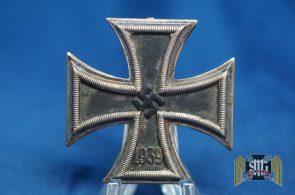
- 1914 Iron Cross 1st Class[17]
- 1918 Wound Badge in Silver[17]
- Commander’s Cross of the Order of Military Merit (Bulgaria) with War Decoration, 16.7.1918[18]
- 1929 Nuremberg Party Day Badge, 1929[18]
- The Honour Cross of the World War 1914/1918 with Swords, 1934[17]
- Anschluss Medal, 1938[17]
- Sudetenland Medal, 1939[17]

Do you have
Unwanted Militaria?
Whether it’s individual pieces or full collections, we’ll buy it!